| Nonlinear force-free fields |
|
|
|
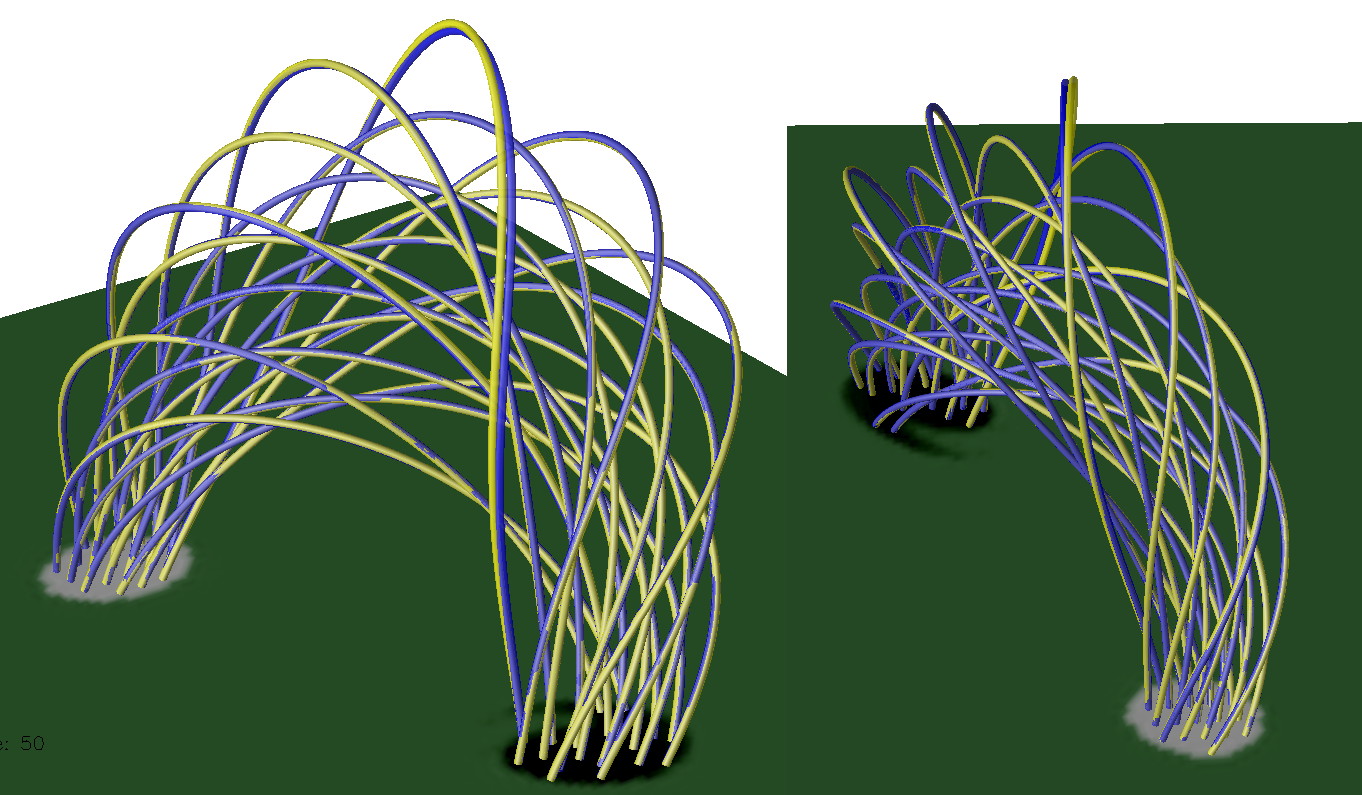
Force-free fields: The images above show views from two angles
of a test calculation of a force-free
magnetic field. Force-free fields have the property that the electric
current density associated with the magnetic field is parallel to the
field. The governing equations are surprisingly difficult to
solve in general, in part because they are nonlinear, and iterative
numerical methods are used.
The images here illustrate a bipolar test case. A set of magnetic
field lines (in blue) and a set of stream lines of the electric current
density (yellow) are shown, starting from the same boundary points in the
lower boundary. Ideally, the blue and yellow curves should coincide.
The two sets of curves very nearly agree: the differences reveal
limitations in the numerical method. The white and dark patches
in the lower boundary show the location of electric currents emerging
from the boundary, and returning to the boundary, respectively. These
currents twist the field, as shown. [Click on the images for a zoomed
in version.]
The animation below illustrates the iteration procedure used to obtain the agreement. |

|
|
Solar modelling:
Nonlinear force-free fields provide simple models for magnetic fields
in the Sun's corona (a thin, hot, ionised gas above the Sun's surface).
These fields are the source of energy for solar flares, which are magnetic
explosions in the corona. Large flares produce effects on Earth and
in our local space enviroment. They can lead to increased numbers of
accelerated particles which cause damage to satellite electronics, and
may pose radiation risks to astronauts and commercial passengers on polar
flights. There is considerable interest in applying nonlinear force-free
modelling to determinations of the Sun's magnetic field at the
surface of the Sun (the solar photosphere), to "reconstruct" the magnetic
field in the corona. The aim is to better understand physical
processes underlying flares.
|
| Recent work: The image at right shows an example of a recent coronal field reconstruction from solar photospheric data, performed by A/Prof. Mike Wheatland and the University of Sydney as part of an international collaboration aimed at improving coronal magnetic field modelling capabilities. The state-of-the-art data used is from the Japanese Hinode satellite. This image shows a reconstruction of magnetic field lines in a large "active region" on the Sun (a region around sunspots), observed during April 2007. Clicking on the image provides more information on the calculation, including comparisons of the calculated field with observed structures in the solar corona. |
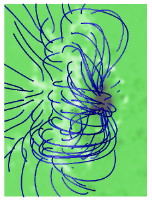
Magnetic field reconstruction for AR 10953. |
|
Return to Mike Wheatland's home
page
|
| Page maintained by m.wheatland@physics.usyd.edu.au | Page last updated Tuesday, 03-Sep-2013 09:28:30 AEST |