ROD CROSS HOME PAGE

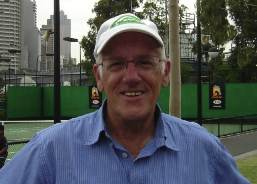
Melbourne Park, Australian Open


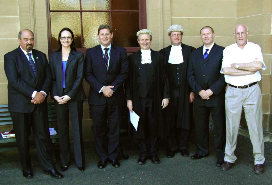
Supreme Court, Darlinghurst, Sydney

 
        AT COURTS   


Published by Springer March 2011

Hardcover, 322 pp Contents, Index and 

Chapter 2 now available for free at

http://books.google.com.au/books

 Contents         Chapter 2

or download from

http://www.springer.com/physics/book/978-1-4419-8112-7


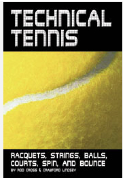
Technical Tennis  by Rod Cross and Crawford Lindsey

What is the single most important property of a tennis racquet?

How do you create maximum spin? Where on the racquet

should you hit the ball? How does a ball bounce? How many

cows does it take to string a racquet? This book answers these

and other elusive questions that have plagued hackers and experts alike,

and will turn hours of mindless practice into a focussed application of

principles affecting the impact and flight of the ball.


Available from www.racquettech.com,  amazon.com etc (only $10 for priceless information!).  Also available in Spanish and Japanese.

Remember this: ÒSex is good but tennis lasts longerÓ Freud, 1938. See book ÒSex as a sublimation for tennisÓ by Saretsky.

http://twu.tennis-warehouse.com/learning_center/spinexperiment.php has more recent results and 300fps movie files on spin generation by different tennis strings (April 2010).

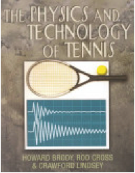
See also The Physics and Technology of Tennis by Howard Brody, Rod Cross and Crawford Lindsey

______________________________

SPORTS PHYSICS MOVIE CLIPS

______________________________


INDIVIDUAL SPORTS


_______________________________________________
PHYSICS OF BOUNCING BALLS AND OTHER OBJECTS

COLLISIONS              GENERATION OF BALL SPIN               SPINNING TOPS

 MORE TENNIS    and      GRAND SLAM DATA     and     TENNIS STATISTICS

SPAGHETTI TENNIS STRINGS         and           SILLY PUTTY

BALL TRAJECTORIES         and         DUNE BUGGY TRAJECTORIES

WOBBLE BOARDS & MUSICAL SAWS           MARIOTTEÕS CRADLE (aka NewtonÕs cradle)

___________________________________________________________________

Here is a very elegant example of two double pendulums working in unison,

passing our front door at 300 fps. The next clip shows that gravity is not the

only force acting.  Muscle action is needed to swing each pendulum segment.

Enjoy the videos and marvel at the physics and biomechanics involved.


How does he do this ÒOllieÓ? A skateboard rider can jump in the air with the board

almost glued to his feet. The physics can be seen more clearly is this

 slow motion demonstration with a tennis ball and two pieces of wood.


It is not well known, but the Physics Department hosts a family

of kookaburras.  Here is Mum with a juicy worm. And off

to get another one.  Amazing aerodynamic control!


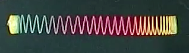
A falling slinky does something totally unexpected.

The bottom end waits for the top end to fall before

the bottom end starts to fall. See also http://youtu.be/eCMmmEEyOO0


________________________________________________________________

LISTEN TO A BELL   (recorded at the same volume and ball speed) hit with  (a) a golf ball   or   (b) a tennis ball

Why are the sounds so different? ItÕs the same fundamental reason that some bats and racquets have bigger sweet spots than others. The amount of vibration depends on the ratio of impact duration to the vibration period. The bell might sound tinny if you use internal speakers. Try it anyway as a test of the bass response of your internal speakers. The fundamental frequency is 975 Hz. Internal speakers will not respond at all to the f < 200Hz racquet sounds included on the tennis page.      

___________________________________________________________________

PUBLICATIONS  (and  TENNIS MAGAZINE ARTICLES)
PLASMA PHYSICS DEPARTMENT 1960-1995 – HISTORICAL PHOTOS

FORENSIC PHYSICS                  Book: evidence for murder (UNSW Press, 2009)

___________________________________________________________________

Brief CV

Born 1943. Lived in Berry, NSW until age 14 then moved to Forbes. B.Sc. Dip. Ed at Sydney University. PhD in plasma physics in 1968. From 1968 to 1996 I worked in the Plasma Physics Department at Sydney University, specialising in Alfven wave studies in the TORTUS tokamak. I retired in 2003 as an Honorary member of staff, to continue work on the physics of sport and forensic physics.

Contact: cross@physics.usyd.edu.au     Ph: +61 2 9351 2545   or   +61 02 9351 2545

___________________________________________________________________


      Escher                    Movie clip of me reflected in a 2 inch steel ball (click ball)